The Day the Sea Turned Silver
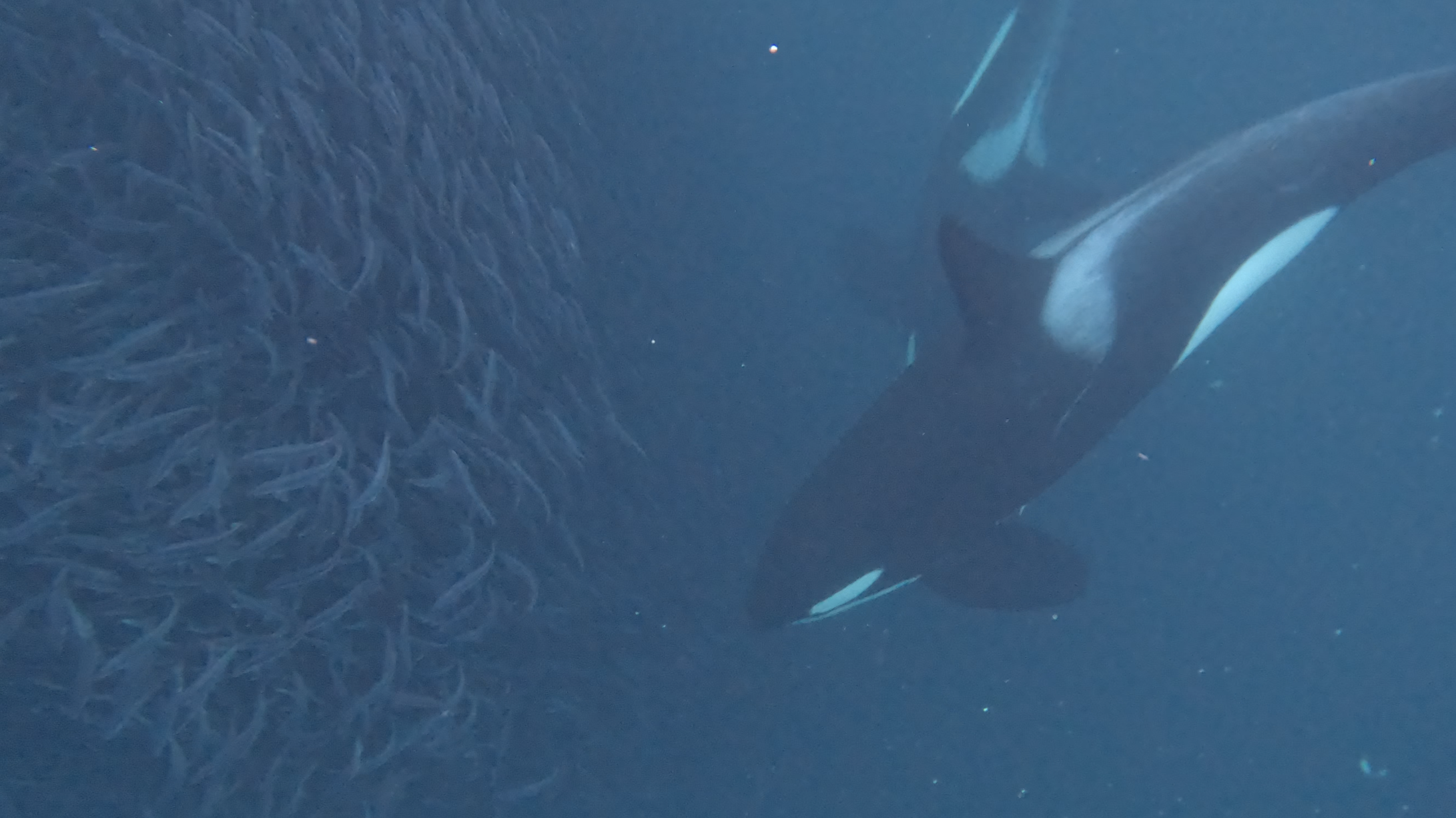

Some moments on expedition stay with you long after your jacket and gloves have been hung up to dry. One of mine began with a flash of white beneath the surface of the cold, dark Arctic water—a single orca’s saddle patch, barely visible but immediately recognized by everyone aboard the zodiac. Then another appeared. Those white patches skimmed under us in smooth, deliberate movements, each one a clear sign that a hunt was underway.
The only sounds breaking the frigid air this day were the sharp exhales of the orcas as they surfaced, maybe a few excited squeals and giggles from our teammates aboard the zodiac as well. Each breath of these wild mammals carrying power and purpose, a single whale in its natural environment is a sight to see, but an entire orca family working together to corral herring? There are no words that can truly describe the experience of this; but I’ll try.


The formation of a herring baitball is one of the most complex cooperative feeding strategies in the ocean. The orcas swim in large, overlapping and tightening circles, flashing their bellies of white to confuse and compress the fish together. Once the herring are packed into a tight circle—hence the term baitball—the orcas begin selecting individual fish. From above and below, we watched as they used powerful tail slaps to stun the foot-long herring, picking them off one by one, feasting on their chosen delicacy. With wide (goggled) eyes, we watched this spectacular event; flashes of black and white, fish moving as a giant coordinated mass, the sound of high-pitched whale calls mixed with the movement of water at the surface. Soon the sea around us shimmered silver as fish scales drifted through the current, dissipating in every direction.
I watched one by one as my team members entered the water quietly during each of these events, positioning themselves to observe this natural phenomenon below them, wanting to be a part of the frenzy and witness it with their own eyes. One of the days, however, as my teammates readied themselves for another spectacular encounter, I wondered what it sounds like when these orcas work together in this manner. When you’re in the water there’s so much sensory information—sights, sounds, textures, you’re cold, there’s movement and your heart is beating rapidly. There’s so much to pay attention to, you miss out on a few of the key elements of this experience. I wanted to know what it sounds like when the orcas are working together to form a baitball, and I wanted to know what it sounds like when the orcas are working together with humans in the water with them. I watched my teammates slide off the side of the zodiac just as the herring started to group together and I stayed on the boat. Having just completed my doctoral research validating the impact of citizen science in these polar regions, this was data I knew I had to collect. This data could help inform future generations of scientists and ocean conservationists, having impact far beyond this single experience. I felt a sense of responsibility to collect it; this was big.

I readied the hydrophone kit, checked the settings, and secured the line. As I worked, I felt a shift—subtle but unmistakable—through the air and the floor of the zodiac. Moments earlier, the energy had been bright and chaotic with the orcas moving in every which direction; now it felt deep, tonal, and heavy. Low vibrations pulsed through the water making their way through the hull of the boat. This was a good note; before you see humpback whales underwater, you feel them.
That was my cue.
I lowered the hydrophone into the water, counting aloud as it descended. Two, three, four, five, six, seven meters. The cable disappeared into the darkness as I placed the headphones over my ears—just as the ocean erupted. Quite literally.
A single humpback whale lunging through a baitball is powerful. Three whales, each around fifty feet long, hitting the surface almost simultaneously is something else entirely. The strike sent a deep boom through the water and a shockwave of motion across the surface. Massive jaws broke through the baitball the orcas had so carefully constructed. Water exploded upward in every direction. A tsunami-looking wave erupted all around us. Gulls dove. The sea shifted from exciting to chaotic. It was magic. Herring, orcas, humpback, humans, me, the hydrophone, and my phone camera—I was capturing every single moment of it!
My teammates erupting in cheers from their places in the water, the spray of humpback and orcas’ breath all around us, the fish scales, the baitball, the gear, the splash of water, again and again and again as the humpback lunge fed in every direction. The baitball reformed, broke apart, and reformed again as the whales lunged, splashed, and lunged. This was a once-in-a-lifetime experience for those in the water, now memorialized by the capture of sound (and topside video) that will be replayed countless times.
My hope is that this experience—and the data collected—extends far beyond this single moment in time. I want these recordings to help inform policy and decision-making in these waters, highlighting just how alive, dynamic, and interconnected these ecosystems are. Our goal at the Seabirds is to place this data into the hands of scientists, students, artists, researchers, and anyone who seeks to better understand our ocean systems and protect them for generations to come. I’m grateful for the opportunity to do this work and for the people I get to share it with, and just what a gift it is to know what these encounters look, feel, smell, and sound like.
Xo,
Ash
Relevant Expedition Information:
- Date: 2025 Nov 7 - 13
- Name: Hobby LAB Expedition 2025
- Location: Tromsø, Norway
- Partner(s): Center for Open Exploration
- Vessel: MV Polarfront, run by Waterproof Expeditions